
This morning I walked down the hill of Point Loma into Ocean Beach, and my mind drifted, as it often does before a board meeting, to a question worth asking after thirty years around the same table: why am I still on this board?
I’ve sat on this board for three decades. I’ve watched people rotate in and out, watched leadership change, watched the business itself change shape more than once. Heading into another meeting next week, I found myself genuinely reflecting on it – not out of ego, but out of curiosity. What actually earns you a seat that long?
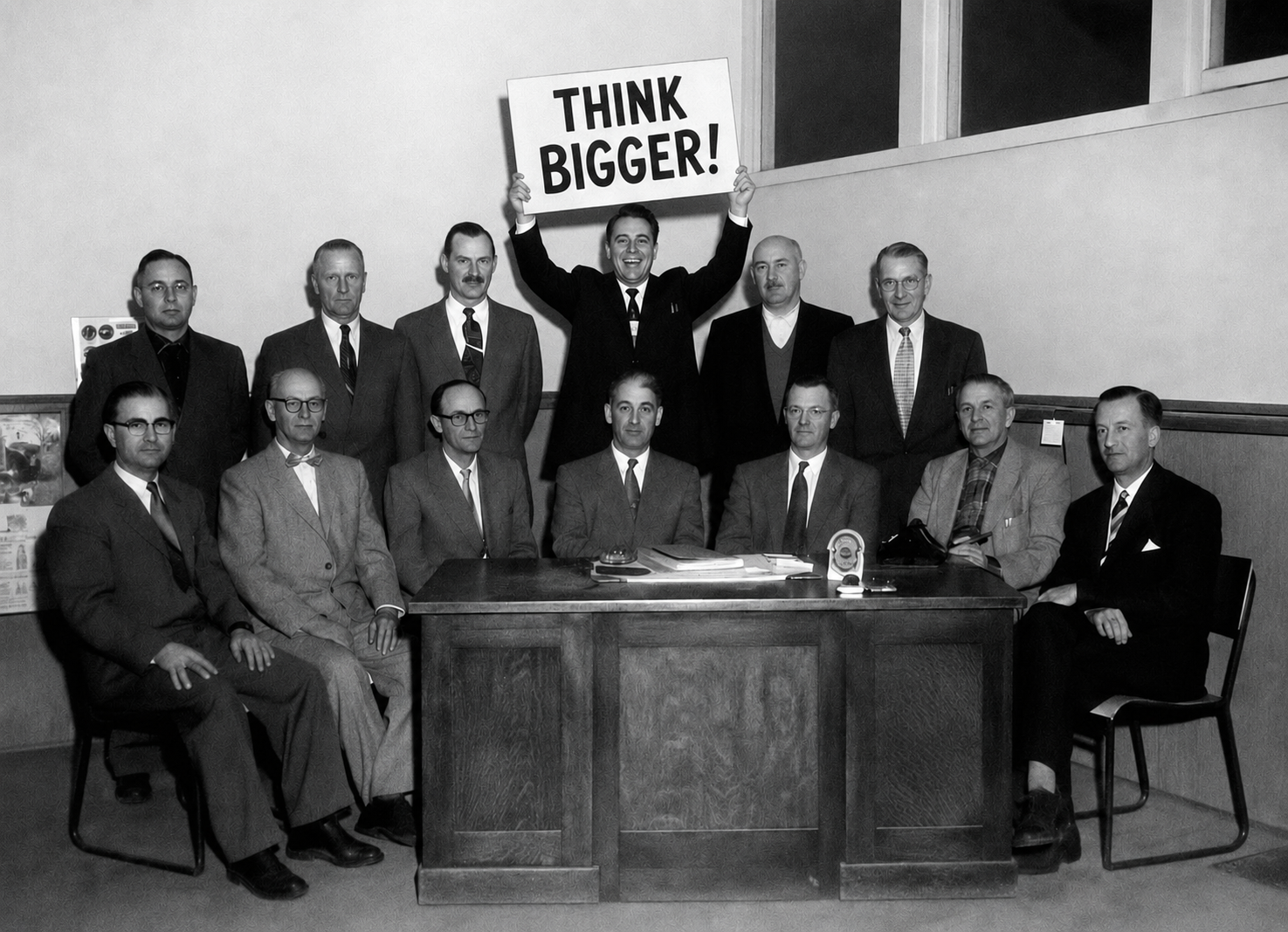
I landed on one answer: thinking bigger and more audacious than anyone else in the room. And I don’t mean that casually. I mean it as the deliberate habit that’s shaped my entire career – thinking more out-of-the-box than anyone else.
Here’s how I arrived at that habit. The years of formal training I went through in St. Louis with Ralston Purina Company – spending six months shadowing the CEO or president of every major division, from soybean processing to hog genetics – were never about that. That program was built entirely around incremental gain: pushing the peanut forward a little further, a little further, quarter-over-quarter goals and the resulting bonus. It was never about the big, audacious goal.
So it wasn’t the training that made me a big thinker. It was watching a handful of people who were brought into those meetings over time – specifically two who always amazed me, Dave Allen and Fred Wynn of Boston Consulting Group. They weren’t chasing hundred-million-dollar deals while everyone else optimized the margins on last year’s plan. They were talking about billion-dollar outcomes nobody else in the room believed were realistic.
I watched them, I saw the benefit, and I saw how everyone – most importantly, the CEO of that division – always wanted them in the room. I decided right then that this was the person I wanted to be. So in every meeting, no matter how menial it seemed, I pushed for a much bigger outcome – a redefinition, a reframing, even crazy potential partnerships – with one rule: it has to be bigger than anyone else in the room.
I’ve been building on this ever since I observed it during my training at Ralston Purina. A shout-out to Dave and Fred for teaching me that companies will pay a lot of money for a different look and thought process than their current management team has. I’ve carried that lesson from my original training into almost every meeting I have today as a board member or advisor. It’s even shaped how I mentor at the Cathedral High Business Institute, where we’re guiding 40 business-oriented entrepreneurs and potential managers to think bigger.
This isn’t a knock on big corporate boardrooms – it just is what it is. Most people in big corporate rooms are incrementalists playing it safe. Smart, capable people – but their instinct is always to ask how they can improve this a little. My instinct went somewhere else: what business are we actually in, and does it need to be redefined entirely? Incrementalism was never going to get us where we needed to go.
And that instinct hasn’t gotten less relevant with age – if anything, it’s gotten more useful. These days, the people I find myself most drawn to are the ones working in artificial intelligence. I’ll sit down with them and they start describing a planet I never thought could exist within my lifetime, let alone my career. A different scale entirely.
Those are exactly the people I want around my table now – the ones who make my old definition of “big” look small.
So here’s my message this morning, walking down into Ocean Beach with the fog still burning off: if you want to stay relevant in any room, stop competing on the incremental changes everyone can already see. Look for the big, audacious goal nobody else wants to name, because they don’t believe they can get there. Name it anyway. Then do the harder work of figuring out how.
That’s not bravado. That’s the value-add. And – hint, hint – Claude can help immensely.
